Showing posts with label feminist. Show all posts

Saturday, 7 March 2020

Necessity is the mother of invention

International Women's Day is marked on March 8 every year and celebrates the cultural, social, economic, and political achievement of women around the world. Women of all walks of life have contributed to the development of science, technology, engineering, and medicine. Here are a few examples.

Sarah Goode (1855-1905), Inventor of the Folding Cabinet Bed

Goode was an entrepreneur who had many customers with very small apartments. She invented the folding cabinet bed to save space. It was a desk by day and a bed by night. When Goode registered her patent for the folding cabinet bed in 1885, she became the first Black American woman ever to get a United States Patent.

Her aim was to balance out the weight of the folding of the bed so that it could be easily lifted up, folded and unfolded, and to secure the bed on each side so that it would stay in place once it was folded. She provided supplementary support to the centre of the bed when it was unfolded.

Mary Golda Ross (1908-2008), engineer

Mary Golda Ross was the first known Indigenous female engineer, and the first female engineer in the history of Lockheed. She was Tsalagi (Cherokee). She was one of the 40 founding engineers of the Skunk Works project at the Lockheed Corporation. She worked at Lockheed from 1942 until her retirement in 1973. She is best remembered for her work on aerospace design – including the Agena Rocket program – as well as many "design concepts for interplanetary space travel, crewed and uncrewed Earth-orbiting flights, the earliest studies of orbiting satellites for both defense and civilian purposes."

Asima Chatterjee (1917-2006), chemist

Asima Chatterjee was a chemist who is greatly renowned for her contributions to organic chemistry and phytomedicine. She developed cancer medicines, anti-epileptic and anti-malarial drugs. She was the first woman to be named a Doctor of Science by an Indian university. She studied at the University of Calcutta and wrote several volumes of work on the medicinal plants of the Indian subcontinent. She was nominated by the president of India as a member of the Rajya Sabha.

Bette Nesmith Graham (1924-1980), Inventor of Liquid Paper

After she got divorced in 1946, Bette took a job as a secretary. Typewriters with carbon ribbons had just come into widespread use, and the old erasers that were previously used just smudged the paper. So, Bette, who had trained as an artist, came up with a mix of tempera paint to paint out her mistakes. Her boss never noticed the corrections. Soon other secretaries wanted a bottle of her special paint, and she realized that she had come up with something that would sell. When Liquid Paper (also known as Tippex and White-out) became a multi-million dollar company, she created two foundations to help women find new careers, especially unmarried mothers. The foundations also created college scholarships for older women and gave shelter and counselling to battered women. She described herself as a "feminist who wants freedom for myself and everybody else."

Fun fact: she was also the mother of Robert Michael Nesmith, the guitarist in the band The Monkees.

Frances Gabe (1915-2016), Inventor of the Self-Cleaning House

Before there was the Roomba, there was the self-cleaning house, with resin walls, waterproof furniture, no carpets, and a device in the ceiling that emits a jet of water, soap, and hot air to dry everything in the room after it has cleaned it. These labour-saving devices were invented by Frances Gabe, who went partially blind for 18 years after the birth of her first child, and grew up accompanying her architect father to work.

Lynn Conway (born 1938), inventor of new computer chip designs

Lynn Conway invented scalable, dimensionless design rules which hugely simplified chip design and design tools; and a new form of internet-based infrastructure for rapid-prototyping and short-run fabrication of large numbers of chip designs.

She was born in 1938 and transitioned to female in 1968. She was fired by IBM but went on to work for Xerox and DARPA.

She has five patents to her name, and retired to Michigan, USA. In Fall 2012, the Institute of Electrical and Electronics Engineers published a special issue of the IEEE Solid-State Circuits Magazine devoted to her career, including an autobiographical account of her career, and commentaries by the former Director of Engineering at HP, a Professor of EECS at U.C. Berkeley, and a Professor of Electrical Engineering and Biomedical Engineering at Columbia University.

Thursday, 17 October 2013

Women's history 101

People often ask, why are there so few famous women writers, artists, scientists, and intellectuals?

They seem to be forgetting that, in previous centuries, it was rare for women to be educated. Women also often died younger due to infections contracted in childbirth.

Women were not allowed to attend university until the 1870s, and even then they were not allowed to graduate.
At the beginning of the 20th century it was very difficult for women to obtain a university education. In 1870 Emily Davies and Barbara Bodichon helped to set up Girton College, the first university college for women, but it was not recognised by the university authorities. In 1880 Newnham College was established at Cambridge University. By 1910 there were just over a thousand women students at Oxford and Cambridge. However, they had to obtain permission to attend lectures and were not allowed to take degrees. 
Without a university degree it was very difficult for women to enter the professions. After a long struggle the medical profession had allowed women to become doctors. Even so, by 1900 there were only 200 women doctors. It was not until 1910 that women were allowed to become accountants and bankers. However, there were still no women diplomats, barristers or judges. (John Simkin)
The first social groups to routinely educate their daughters were the Unitarians and the Religious Society of Friends (Quakers), starting in the 1840s.

When women did succeed in producing literature or scientific research, quite often someone else got the credit for it, or their contribution or achievement was minimised. Even now, there are people who dispute that Ada Lovelace wrote programs for Babbage's calculating engine, and want to impute authorship of the Brontë sisters novels' to their brother Branwell. The scientific achievements of Lise Meitner, Cecilia Payne-Gaposchkin, Hedy Lamarr, Dorothy Hodgkin, Rosalind Franklin, Katherine Jones, Jocelyn Bell-Burnell, Caroline Herschel, and many others, are forgotten or sidelined. I did not learn about any of these women at school - I found out about them by researching on the internet, and reading blogposts from the Finding Ada project.

Many nineteenth-century female scientists and mathematicians were told that their scientific and mathematical activities were bad for their womb. Many were prevented from attending university, or not allowed to graduate, or made to work in a separate laboratory from the men.

The work of female writers, poets, artists, composers, and playwrights suffered a similar fate. Artemisia Gentileschi's paintings were attributed to her father. The Nobel Prize for Jocelyn Bell Burnell's discovery of pulsars went to her male PhD supervisor. The work of the women Pre-Raphaelite and Impressionist artists is largely forgotten.

A similar fate happens to Black & minority ethnic (BME) and LGBT scientists, authors, and heroes. And if you are a woman and BME and LGBT, then you are doubly or triply doomed to be sidelined. Just look at the marginalisation of Mary Seacole, Edward Carpenter, Goldsworthy Lowes Dickinson, and many another BME and/or LGBT person.

Even today, women's novels are marketed as less serious than novels by men. They also receive less reviews in serious journals.  The novels of white male authors are taught on English literature courses; the novels of female authors are taught on courses of women's studies or women's literature. Maureen Johnson writes:
For much of history, women read the works of men. Every once in a while we see a woman cracking through, maybe changing her name, maybe hiding her work, or maybe breaking through the strength of her genius or good luck or both. Then we see a huge break in the early 20th century, a flux of brilliant women. Women start to climb into the bestseller charts, but not so much into the reading lists.
There is no doubt that women (despite massive disadvantages) have achieved great things in every field of artistic, literary, and scientific endeavour, but all too often, they are forgotten, sidelined, their achievements dismissed or diminished, their work not taught in schools or universities. The corpus of literature that is considered "the canon" is overwhelmingly by white men (usually dead white men, usually heterosexual). No-one is saying that these authors should no longer be taught; just that "the canon" should include women, BME people, and LGBT people.

Inspirational women

All my Finding Ada blogposts in one place:

Katherine Jones, Viscountess Ranelagh, sister of Robert Boyle. She conducted chemistry experiments.

Wendy Hall, computer scientist

Anita Borg, computer scientist

Caroline Arms, metadata pioneer

Hedy Lamarr, inventor

Lisa Barone, SEO expert

Cecilia Payne-Gaposchkin (May 10, 1900 – December 7, 1979) was an English-American astronomer who in 1925 was first to show that the Sun is mainly composed of hydrogen, contradicting accepted wisdom at the time.

Thursday, 28 March 2013

Her name was Reeva Steenkamp

The other day, I attended a talk on feminism, and one of the women on the panel described how South Africa was gearing up for a major campaign on rape and violence against women, when (and I quote) "a fluffy two-dimensional model got murdered and it was all over the news" (thus knocking the campaign out of the headlines).

Her name was Reeva Steenkamp. She was a lawyer as well as a model. She was a feminist. She had tweeted support for the anti-rape and anti-violence campaign. It was not her fault that she was killed. It's not her fault that the media were more interested in her good looks and her modelling career than in the fact that she was a lawyer and a feminist.

As feminists, we should look behind the headlines and the media hype to see what is really going on, and not mistake the sexist and patriarchal nonsense peddled by the tabloids for anything resembling reality. And we should not refer to other women with the sort of insults that patriarchy dishes out.

I would have challenged the woman on the panel who said this, were it not for the fact that a woman in the audience had said something even more outrageous, which I also felt the need to challenge.

Tuesday, 11 September 2012

The Goddess is not your bitch

Laurie Penny, in an excellent critique of Naomi Wolf's book, Vagina, has drawn attention to a worrying new trend.
Throughout Vagina, Wolf refers to something called the 'Goddess', a sort of wibbly-wobbly divine feminine energy that can be woken by appropriately angled vaginal massage and a nice bunch of flowers, a strategy known, and I really wish I were making this up, as the 'Goddess Array'. This 'Inner Goddess' idea is having a moment right now.

It crops up as a clunky motif in the wildly popular Fifty Shades of Grey series, in which the protagonist's 'Inner Goddess' responds to the virile attentions of the millionaire stunt-dick in a variety of interesting ways. As the heroine administers a simple blow-job, the reader is informed that her 'inner Goddess is doing the merengue with some salsa moves'. Imagery matters, even clunky, awkward imagery: in Wolf's hands, this weirdly retro goddess conceit becomes a manifesto, informing the female reader that no matter what her life may look like, no matter what gender inequities she may experience every day, there is something wonderful, special and mysterious about being a woman, and especially about being a woman receiving sexual attention from a man, that should be its own reward.
The idea of the Goddess does not have to be - indeed, should not be - some fluffy flower-bedecked Persephone tripping through the meadows waiting to be abducted by Hades.

Goddesses include the hag Lilith who rejects men, the subversive Baubo who makes Demeter laugh, Eris who sows dissent, Ishtar who destroys, Kali the slayer, Pele of the volcano, and Artemis the hunter.

Because the Goddess is 'Mother Nature', she is not always sweet and kind; sometimes she is the terrible mother, dealing death mercifully. In Paganism, death is regarded as a natural part of the cycle of birth, life, death and rebirth.

It's true that the idea of the Goddess was first popularised by a woman who thought that women were somehow essentially different from men, namely Jacquetta Hawkes, a prominent enthusiast for the Goddess in the 1930s, who believed that women and men were fundamentally different and that the role of women was to remain in the home and bring up children. This is rather ironic in view of the next generation of enthusiasts, the separatist feminists of the sixties and seventies. And clearly Naomi Wolf's inner goddess, and the inner goddess of Fifty Shades of Grey, are also pandering to socially conservative essentialism and the idea that women are just there for men to have sex with; not as beings in our own right.

Can we reclaim the idea of goddesses from this essentialist and socially conservative discourse? I think the first step is to regard them as goddesses, not the Goddess - if they are plural, there's a range of gender expressions available, and there can also be transgender goddesses. Each has her own story and her own political stance. Each expresses her gender differently, which encourages us to see that gender is a social construct and not an essential attribute.

As Laurie Penny says, we don't need the kind of feminism peddled by Naomi Wolf; we need a feminism that affirms women's worth as human beings, and campaigns for women's rights around the world, and that fights back against the current tidal wave of misogynistic rhetoric and legislation.

The Goddess should be on the side of real feminism, not putting women back in frilly nighties in the bedroom. She is not the bitch of patriarchy - she is the wild instinct of women yearning for freedom and human rights.

Sunday, 9 September 2012

Suffragettes and tea rooms

Who knew that researching the tea rooms where suffragettes held meetings would provide such a rich vein of historical information? Elizabeth Crawford at the Woman and her sphere blog has been researching this, and appeared on Radio 4 to discuss it.

Thursday, 7 July 2011

Women's rights around the world

The United Nations has just published a report on women's rights around the world, and The Guardian has created an interactive timeline of when women got the vote in various countries around the world, as this is a key indicator of women's rights being taken seriously.

However, women's rights more generally are still a work in progress:
More than half of working women in the world, 600 million, are trapped in insecure jobs without legal protection, according to the first flagship report of the new agency UN Women. A similar number do not have even basic protection against domestic violence, it finds, while sexual assault has become a hallmark of modern conflict.

Wednesday, 6 July 2011

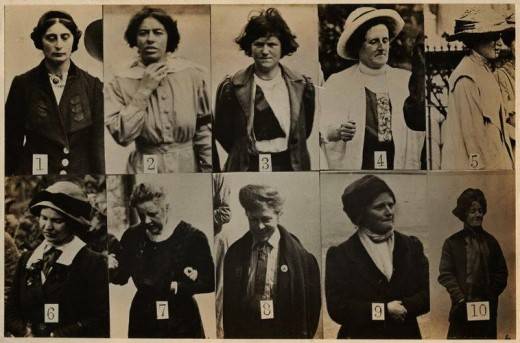
Suffragette surveillance photos

BoingBoing has a great blogpost about surveillance photos taken by Scotland Yard of suffragettes in 1912.

The original article from which the photos came was in the BBC Magazine in 2003.
"On the one hand, the state considered them dangerous terrorists, but on the other it simply did not know what to do with them," says Ms Tulloch.

"The police and prison officials were so worried about what to do they made sure that every step they took was authorised by the Home Office. In the records you can find daily communications between the governor of Holloway Prison and Whitehall. In that era it was extremely rare for government to communicate so quickly."

But the police surveillance did nothing to stop the movement - nor did it dim the growing support they were finding in the country.

There's also a potted history of the suffragettes on the BBC site.

Tuesday, 5 April 2011

Mary Wollstonecraft talk

On Sunday 22nd May, after morning service at 11 am in the chapel of Harris Manchester College (Mansfield Road, Oxford, OX1 3TD), there will be a talk at 1 pm by Lyndall Gordon, the author of Vindication: A Life of Mary Wollstonecraft, concerning the life and times and Unitarian connections of the 18th-century feminist (wife of William Godwin, mother of Mary Shelley, and “the foremother of much modern thinking about education and human rights, as well as about women's rights, female sexuality and the institution of marriage"). Please bring your own sandwich lunch; for directions to the college, consult the Chapel Society website.

Tuesday, 30 March 2010

Feminism and sexuality

Two articles about pornography and our society's hypocritical attitude to it.
The Power of Porn Stars: Why We Love, Hate, Fear and Want Them
Girls involved with paid sex, who gain benefit from their position as females while remaining independent, are feverishly desired, yet punished for their "transgressions."
By Virginie Despentes
Quiet Riot Girl - This is Hardcore: A feminist's journey into porn
Feminists and others have rightly called attention to the exploitation of women in the pornographic film industry. However, the first article points out that because of our society's assumption that a woman who is sexually active is also a brainless bimbo, actresses who work in porn films can't get jobs in other films, so are forced into a porn-film ghetto.

The second article points out that women can gain pleasure from pornography too; the kind of power games played in these films are part of many people's sexual pleasures, and just because people indulge in them in the bedroom does not mean they have to be acted out beyond the bedroom door. In fact, the playing of such games can resolve anxieties about power. The sociologist Michel Foucault liked S/M for this very reason.

Yes, treating people purely as sex objects is wrong; but lust in itself is natural and healthy; and by eroticising what we fear, it can be transformed into something else, something less frightening.

Monday, 22 March 2010

The naked lady

My friend Cat just tweeted about the blog of Tessa Chernoi, entitled Ramblings of a Naked Lady, in which she talks about her experiences of nude modelling and how it has enabled her to take pride in her body, and to help other women to do so too. She writes:
This enlightenment is also something that feeds my own photography, I don't care who she is, what she looks like, I would love to photograph every woman I meet. I want to be there when they discover that they are beautiful. My greatest triumph to date has been the reaction I received when I showed a good friend the pictures I had taken of her one evening as we tried to mend her broken heart with red wine. She started crying and asked how I had made her look so beautiful. I replied that I hadn't done anything. She was beautiful and all I did was see it, and photograph it.
How beautiful, and what a wonderful thing to do. Women are so constrained by the narrow mainstream definition of female beauty - it's time we reclaimed our bodies and celebrated them.

Friday, 19 March 2010

Bluestocking of the Week: Lisa Barone

My friend Kirsty just tweeted about an article by Lisa Barone rebutting an article in Canada's Globe and Mail claiming that men are better than women at blogging. And the offending article was written by a woman.

Lisa writes:
if you went to The Globe and Mail site expecting to read statistics about how men dominate the blogosphere and researched ideas as to why that was so, you would have come away disappointed.

Instead, Margaret did what women too often choose to do to one another – she cut them down for sport.

Margaret’s article featured nothing but a stereotyped opinion as to how blogging is really just a man’s task, similar to driving a snowmobile straight up a mountain, she says. Us, girls, just don’t have the stomach for opinions and pissing contests. Women are not interested in these sorts of things. We’re more restrained and less concerned with public displays of prowess.

Lisa Barone is the Chief Branding Officer of Outspoken Media.

Tuesday, 9 March 2010

I am woman, hear me roar

I have just watched a fascinating documentary on BBC iPlayer that completely changed my view of second-wave feminism. When you realise the utter sexism that most men (and many women) espoused in the late 1960s and early 1970s, it's hardly surprising that many women thought that men were a write-off.

And in fact, many of the ideas which I had thought were third-wave feminism were actually formulated by the second wave - ideas like the social construction of gender, for instance.  Also, second-wave feminists invented consciousness-raising groups, and demanded equal pay for equal work, and abortions, and contraception, and the right to walk down the street at night without being in danger of getting raped or knifed.

And the women interviewed in the documentary admitted that political lesbianism was a bad idea, because it wasn't fair to real lesbians.

Monday, 18 January 2010

Worrals of the WAAF

Worrals of the WAAF is clearly a feminist icon - feisty, independent and a pilot. According to the Gad, Sir! Comics blog:
Captain W E Johns had written and published no fewer than eleven (prose) books about Flight Officer Joan Worralson of the Women’s Auxiliary Air Force, starting with Worrals of the WAAF in 1941, previously serialised in Girl’s Own magazine. Like her more famous male predecessor, Biggles, Worrals was a pilot known by an abbreviation of her surname, had a sidekick nicknamed after her physical appearance (“Frecks”, rather than “Ginger”), and showed an alarming propensity to stumble on spy rings while on routine missions. There was no romance, Worrals’s family never showed up, and she acted for King and country rather than personal interest.
She's plucky, intelligent, independent and in charge of her own plane - what's not to like?

The author of the Worrals books, W. E. Johns, also wrote the Biggles books, of course, and several science fiction novels. His politics were clearly different from other children's writers of the era, as according to Wikipedia:
Unique among children’s writers of the time, from 1935 Johns employed a working-class character as an equal member of the Biggles team - "Ginger" Habblethwaite, later Hebblethwaite, the son of a Northumberland miner (we never learn his real Christian name, and he proclaims himself a Yorkshireman once or twice).
Other less-famous characters created by W. E. Johns include commando Captain Lorrington "Gimlet" King; aviatrix Joan "Worrals" Worralson (essentially a female Biggles, created at the request of the Air Ministry to inspire more young women to join the Women's Auxiliary Air Force); and pioneering astronaut (ex-RAF, naturally) Group Captain Timothy "Tiger" Clinton, who first rocketed into space in 1954.

Tuesday, 12 January 2010

The changing face of marriage

I've just been watching a fascinating documentary on BBC iPlayer about the history of British marriages in the last fifty years. It shows how much marriage has changed. Kirsty Young interviewed lots of couples and marriage guidance counsellors to explore the changing concept of marriage: from an institution to a relationship.

One significant factor was the availability of divorce, which meant that people actually had to work at it rather than taking it for granted, and that they could escape miserable and failed marriages. But until the Divorce Reform Act of 1969, a divorce was still quite difficult to obtain; one or other party had to be at fault. After that, separation could be grounds for divorce. By seeing marriage as a terminable arrangement, this completely changed the way people viewed marriage: it means that the quality of marriage matters, and it is socially acceptable to end one.

The Second World War had a huge impact; there were 30,000 divorces in 1946 (more than three times the pre-war numbers) because people's expectations of marriage had changed, and many people had had affairs while they or their partners were away, or both parties had simply changed in the intervening years since they had last seen each other.

Then there was the advent of marriage guidance (the National Marriage Guidance Council was formed in 1946). The NMGC promoted the concept of companionate marriage — the idea that the partners are equal and provide companionship for each other.

Another significant change was women going out to work. In the early 50s, only one in five women worked. This changed fairly rapidly in subsequent decades. At about 25 minutes into the documentary, Kirsty Young takes a pot-shot at that idiot John Bowlby, who placed having a mother in full-time employment on the same level as war and famine in the scale of calamities that might befall a child.

The increasing availability of contraception also had an effect, together with increased expectations of sexual fulfilment. Until the "sexual revolution", people often had little or no sexual experience when they got married, so had no basis for comparison to know if their partner was any good in the sack. Reliable contraception allowed them to gain pre-marital sexual experiences; and also meant that they could choose whether or not to have children. And increased availability of knowledge about sex (orgasms and so on) meant that expectations were raised, and extra-marital affairs became more common. Prior to that, they were pretty clueless about sex; a NMGC survey in the early 50s found that only one in three couples had a fulfilling sex life. A 1958 NMGC booklet, Sex in Marriage, pointed out that some couples, once they get closer, might like to try having sex with no clothes on; and pointed out that some women might need more than orgasm before they were satisfied. (Hurrah - multiple orgasms!) People were also clueless about conception and contraception - at the beginning of the 1960s, one in five women were already pregnant when they got married. Many others died of botched abortions.

Feminism also had an impact, encouraging women to expect economic, intellectual and sexual freedom, and legal and social equality. Men started to help with the housework, or with pushing the pram or holding the baby in the late 1950s. (The next programme in the series deals with feminism and sexual liberation.)

Education (including sex education) improved massively, making people better informed about life and about the choices available to them.

All of these factors mean that marriage at the end of the twentieth century was a completely different concept than it was at the beginning of the century. So, if you are one of those people who thinks that same-sex or polygamous marriage would change the concept of marriage beyond all recognition, you are closing the stable door after the horse has bolted.

Monday, 11 January 2010

Only women bleed

I see radical lesbian feminist philosopher/theologian Mary Daly has died. The blog-obits have varied between the naffly saccharine (from the Pagans, as per: 'May you rest in the sweet arms of the Goddess and have good joy of the Summerlands!' kind of thing) and the excoriating, taking Daly to task for her failings, perceived or actual. (There's a hilarious piece over at Melissa McEwan's on Daly, in which McEwan, having come to praise her, contorts herself into a flailing ecstasy of right-on self-abasement in the Comments once she's told that Daly was once nasty to transsexuals.)

It's rather difficult to write about Daly, as a man, without being accused of bigotry. A keynote of her playful style was the making of very extreme statements forte con brio which might or might not have been merely throwaway. In this she was like a kind of philosophical performance artist of woman-rage, but the line she trod between radical art-speech and radical hate-speech was, sadly, a narrow one. I'm not sure becoming a kind of mirror-image Tertullian really did her, feminism, or the world much good in the end, nor how deliberate a pose it was. But more on this anon.

Credit where credit is due: Daly wrote some wonderful, profound, clever things that totally put the bomb under the 'kyriarchy' (great word, all credit to her). Beginning with work on the great Jesuit intellectual Jacques Maritain, she moved into skeweringly accurate analyses of patriarchal religious structures, especially in her early works like The Church and the Second Sex and Beyond God the Father. These did much to enable women and men alike to see the hierarchies of institutional Christianity as contingent and Kafkaesque, and in them she laid bare---with lacerating, scornful wit---how deeply that religion's pompous absurdities of practice are in fact rooted in the murky bowels of its theology. (A metaphor Daly would have liked, that.) I find this a tenable if intellectually-unsubtle view, but then Daly was never really interested in nuance: her favourite word was 'BIG!'. I respect Daly a great deal for her refusal to bill herself as any kind of dutiful patriarchal daughter, utterly rejecting any concession, and, sometimes, using language with a kind of bubbling, fierce humour. And may her name be forever blessed for the wonderful coinage academentia: don't we all just know what she meant.

Unfortunately, she then began a period which lasted until her death in which she gradually lost touch with the world around her whilst claiming to see it ever more clearly. As Lord Shaftesbury remarked, '[T]he most ingenious way to become foolish' is 'by a system.' For a deeply learned woman, Daly's scholarship became erratic: she clung, for example, to the notorious 'nine million women' figure for the number of deaths in the early modern Witchcraze, and completely ignored the emergent and specifically radical feminist scholarship of the 1980s which demonstrated that her view of the witch trials was simply mistaken---a note of intellectual high-handedness with other women scholars which sadly came to blight her work. She was not in any way a competent historian (except perhaps, once, of the Church) but ultimately a kind of philosophical propagandist; when history becomes martyrology and persuasion is replaced by propaganda---in however prankish a spirit and in however good a cause---then the scholar ensures the eventual academic evanescence of their own work, because it will have to be redone properly.

This propaganda settled into the form of a radical feminist Manichaeism, in which the world is divided down the middle into men (bad, intrinsically disordered, violent, oppressive and 'necrophile') and women (good, intriniscally oriented correctly towards life and each other, peaceful, oppressed and 'biophile'.) One of the saddest things to watch, as one reads Daly's later works, is the way that the first category grew ever more capacious and the second shrunk ever further as the ideological strictures tightened. By the late 90s, 'women' had come to mean radical feminist lesbians, or, as Daly might have put it, only Positively Revolting Hags who had Crone-ologically seen through the patriarchal pompenile parades, rejected intercourse in favour of Outercourse, and had joyously up-risen into Quintessential Be-ing. As her remaking of the dictionary, Websters' First New Intergalactic Wickedary of the English Language, makes plain, Daly was, alas, no Joyce when it came to wordplay. The experience of being trapped in the book's thuddingly-repetitive, elephantine punning makes me feel like Victoria Wood's wonderful character Kitty, a formidable Manchester matron of decided views, who tells us:

--She said, 'Kitty, do you like fun?' I said, 'No, I don't!--I had enough of that in 1958 when I was stuck in a lift with a hula-hoop salesman.'

(As Daly might have said, 'We may be overthrowing the patriarchy, but I want it to be fun fun fun.') As her throught developed, she appointed herself the arbiter of who of who was not 'a real woman' according to her own exalted criteria, eventually defining which women were and were not worthy of a feminist revolution. Sex-workers, transgendered women, Christians, straight women who enjoy straight sex, mothers of boys, women who love their male relatives, women who have undergone male-derived kinds of psychotherapy---all were eventually excluded in Pure Lust as 'imitation males.' Men, of course, had to go too, via a shady and unspecified process of 'decontamination'. I find it astounding that a woman of Daly's obvious intelligence felt able to use that term in a post-Holocaust world, in which it is a clear and sinister synonym for 'extermination.' As she said:

If life is to survive on this planet, there must be a decontamination of the Earth. I think this will be accompanied by an evolutionary process that will result in a drastic reduction of the population of males. People are afraid to say that kind of stuff anymore.

Change 'males' to 'Jews', 'blacks', or 'gays' and see how it reads. Whether or not she meant this statement seriously, and whether or not anything can be said on the grounds that it's merely playful, philosophical free-association, Daly struck here a genuine note of wistful Stalinism once too often for my liking.

There are a variety of questions that can be raised about Daly's career, beyond the infamous banning of male students from her advanced classes; on the latter, I can see her point, but on the other hand it's little better in my opinion than the ghastly Islington registrar Lilian Ladele refusing to perform Civil Partnerships: in other words, whatever wacko views you feel it incumbent upon you to hold, you have to perform the job you were employed to do fairly. I find it striking that Daly told women to leave the Church en masse, but continued to work for a Jesuit university for over three decades. Intellectually, the main problem is her apparent inability to conceive that there might be other axes of oppression beyond men vs women, and that perhaps class, education, race, and economic status might just possibly complicate such a simplistic binary. It mystifies me that such a sophisticated thinker could be so tin-eared at times. Hers was ultimately not a flexible mind; her intellectual style closely resembles that of that Eagleton-coined atheist pushmi-pullyu, 'Ditchkins', i.e. Richard Dawkins and Christopher Hitchkins. Whereas Ditchkins sees religion itself as an irredeemably corrupting influence on the human mind and writes from a position of withering intellectual certainty, Daly saw the kyriarchical forms of religion as the monstrous leviathan to be slain by herself as a labrys-wielding female Marduk. Both often hit the target and hit it hard; both are often guilty an obtuse lack of imaginative sympathy and intellectual manoeuvrability.

There were other problems: the issues about Daly's unedifying fear and loathing of transsexual women (to whom she implied actual violence should be done) have been well picked over on the blogosphere, as has womanist poet Audre Lorde's famous open letter accusing Daly (in polite terms) of a privilged, colonialist and unconsciously racist mindset and methodology---to which Daly apparently never publicly responded. I'll let you hunt those out for yourselves should you wish to do so.

All in all, I'm glad feminism has moved beyond Beyond God the Father, as it were, jettisoning Daly's utopian flights of fantasy and lurid lesbian neo-hierarchies, despite her importance. Daly once wrote: 'I urge you to sin. But not against these itty-bitty religions, Christianity, Judaism, Islam, Hinduism, Buddhism – or their secular derivatives, Marxism, Maoism, Freudianism and Jungianism – which are all derivatives of the big religion of patriarchy. Sin against the infrastructure itself!' I find in this---Maoism and Marxism aside---a recipe for the reductive suicide of human culture, and an extraordinary sense of intellectual contempt deriving from unconscious feeling of vulnerability to pollution. (She could have done with thinking about Mary Douglas' Purity and Danger a bit harder.) For Daly, there is no point even thinking about, say, the three-thousand year old legacy of Hindu culture, spirituality, literature, art, ritual, architecture, medicine, or philosophy: it is merely an instantiation of the patriarchy. (Someone had better pop Wendy Doniger O'Flaherty a note through.) I find myself questioning whether Daly was really learned enough in, for example, Buddhism or Jungian thought to pronounce them valueless and 'itty-bitty' in this way. Judging by her basic lack of attention to them and the historical errors of her scholarship, I rather doubt it. As she gradually lost interest in any account of literature, psychology, biology, history, or religion which conflicted with her stark worldview, she became increasingly ideologically self-marooned; a great loss to the world, as she had an exceptional mind.

There's one term in particular that I do wish that she had picked up from Jung: enantiodromia, that is, 'the tendency of polarised extremes to come to resemble one another via a process of compulsive unconscious compensation.' Ultimately, Daly was an extraordinarily powerful and yet limited thinker, who took the tools used to construct patriarchal religion and analysed them in great and mordant detail. Alas that she went on to use those tools to erect a house of mirrors, which came strangely to reproduce the original patriarchal edifice. By being hierarchically exclusivist, by claiming privileged access to truth, by erecting purity laws about sex and by anathematizing dissent, Daly created a house in which every surface reflected only her own face. In the end, perhaps the best---and the worst---that I can say about Mary Daly is that after a lifetime's striving in the service of feminist thought and nine or so books, historically she won't even be as important as Camille Paglia, another lesbian feminist and her thorough-going ideological opposite.


Anyway, despite my misgivings above, rest in peace, Mary.

Saturday, 9 January 2010

Patriarchy

Some second-wave feminists insist that there is something essentially female about women; that men are the oppressors; and that the patriarchy is everywhere, insidiously sending its messages of subjugation wherever you are, like a giant phallic panopticon.

I remember in the late 1980s going to join the lesbian society at university, and when I asked why they didn't have a joint society with the gay men, the response was, "They may be gay, but they're still men." (So yeah, obviously part of the patriarchal conspiracy, just by virtue of having tackle. Right.) (Most universities now have a joint LGBT society.) As you can imagine, this was one of the formative experiences that made me a third-wave feminist.

Many second-wave feminists propagate the myth of an ancient matriarchal or matrifocal society. Now, don't get me wrong, I do think this is a rather lovely idea (at least a matrifocal society would be - I'm not sure that matriarchy would be any better than patriarchy), but I doubt that it was ever actually a reality. Though it must be said that there are societies which retain traces of matrifocality, for example those cultures that count descent through the female line, like the Jews do.

What we do know is that from about 500 BCE onwards, there was suddenly a reaction against sex, and particularly sex with women. Celibacy and male friendship were in, and women were out. This phase was particularly virulent until about 500 CE, when it began to abate. Unfortunately, the middle and latter part of this period coincided with the rise of Christianity, which is why that religion was so anti-women. Some of the writings of the Church in this period are eye-wateringly misogynist. Of course, this general negativity towards sex and the body must also have adversely affected men.

In this 14th century illustration from a copy of Euclid's Elements, a woman is shown holding a compass and square, teaching geometry to a group of monks.

In fact, the fortunes of women have fluctuated quite dramatically during the last 2000 years. During the 14th century, women could own property and businesses (which is why we have surnames like Brewster, a female brewer, and Webster, a female weaver, because surnames were formalised in the 14th century). Women could also learn Latin, and obviously therefore many were also literate. Nunneries were not just places of seclusion, but communities of learned women. Things weren't 100% rosy for medieval women, but they were definitely looking up. But then the Reformation created problems for women, because the Virgin Mary and female saints could no longer be venerated, and the Divine was seen as exclusively male. Suddenly, women were very much back to being second-class citizens again.

The view of women as utterly crushed by patriarchy denies agency to women, portraying us as passive victims. Our ancestors were just as capable of feminism as you or I. Take Christine de Pizan, for instance, Europe's first professional female writer, who wrote The Book of the City of Ladies, an important feminist work of the early 15th century:
By 1405, Christine de Pizan had completed her most successful literary works, The Book of the City of Ladies and The Treasure of the City of Ladies, or The Book of the Three Virtues. The first of these shows the importance of women’s past contributions to society, and the second strives to teach women of all estates how to cultivate useful qualities in order to counteract the growth of misogyny ... Christine’s final work was a poem eulogizing Joan of Arc, the peasant girl who took a very public role in organizing French military resistance to English domination in the early fifteenth century. Written in 1429, The Tale of Joan of Arc celebrates the appearance of a woman military leader who, according to Christine, vindicated and rewarded all women’s efforts to defend their own sex (Wikipedia)
Life was hard in the medieval period for everyone; I would rather have been an upper-class medieval woman than a male serf, thank you very much. There were still misogynists around, but some women did have and wield power.

In the seventeenth century, a small army of women marched on Parliament to demand the vote. In the eighteenth century, women again had some economic power and a measure of sexual and intellectual freedom. Things took a down-turn again in the nineteenth century with the construction of middle-class womanhood (the "angel of the house") and the pathologisation of women's sexuality. But then along came first-wave feminism (at last) to campaign for legal rights and suffrage.

Furthermore, focussing on how women are oppressed under the current system obscures the complex hierarchies of race, class, and sexuality. It also obscures the ways in which men are constrained and bounded by gender stereotyping.

First let's look at how race, class and gender intersect. In the typical hierarchical view (circa 1930), a straight white upper-class man would be top of the heap. Just below him would be the straight white upper-class woman and the straight white upper-class gay or lesbian. Just below them would be the white middle classes, followed by well-to-do Asian and Black people (though perhaps the white working classes, being quite racist, would have regarded themselves as above any non-white person). So it would simply not be true to say that men were always regarded as superior to women — it depended on their race and class. Of course, all this is deeply uncomfortable to contemplate — it's not pleasant trying to get inside the mind of a sexist or a racist or a homophobe or a snob.

Second, let's look at how "patriarchal" attitudes affect men. Men are not supposed to dress in certain ways (no skirts, dresses, frills, make-up, nail-varnish, or anything remotely "feminine" — even moisturiser is viewed with suspicion); they are not supposed to show much emotion, and especially aren't allowed to cry. They are not supposed to be interested in "feminine" pursuits - botany, needlework, jewellery-making — even religion and spirituality are seen as a bit "feminine". Men must be taller than their girlfriends; they must not have girls' names (ever noticed how any boy's name that gets given to girls suddenly ceases to be regarded as a boy's name?) Masculinity is hedged about with so many taboos and prohibitions, it's no wonder that men are confused and insecure about it.

If we want to liberate women from the "patriarchy", therefore, we also need to liberate men from it. Otherwise, how can it be completely dismantled?

Tuesday, 29 December 2009

Geraldine Brooks

I just read a review by Cliff Reed of Geraldine Brooks' novel March in The Inquirer, which made me want to go and buy it. Having looked at her other books, I also bought Year of Wonders (which is about the plague year in Eyam in Derbyshire) and People of the Book (which is about a book restorer who restores and investigates the history of the Sarajevo Haggadah).

March is a novel about the father of the March girls in Little Women, and is based on the life of Bronson Alcott, Louisa May Alcott's father. I like novels which throw a sidelight on other novels (Jean Rhys' Wide Sargasso Sea being another excellent example), so this should be an excellent read.
From Louisa May Alcott’s beloved classic Little Women, Geraldine Brooks has taken the character of the absent father, March, who has gone off to war leaving his wife and daughters. To evoke him, Brooks turned to the journals and letters of Bronson Alcott, Louisa May’s father, a friend and confidant of Ralph Waldo Emerson and Henry David Thoreau.

In Brooks’ telling, March emerges as an idealistic chaplain in the little known backwaters of a war that will test his faith in himself and in the Union cause as he learns that his side, too, is capable of acts of barbarism and racism. As he recovers from a near mortal illness, he must reassemble his shattered mind and body, and find a way to reconnect with a wife and daughters who have no idea of the ordeals he has been through.
Year of Wonders should be of interest to British Unitarians, as the village of Eyam is only just up the road from Great Hucklow, the Unitarian conference and holiday centre. The story of Eyam is incredibly moving; I first heard of it at school when I was 10 or 11, and it made a big impression on me; but this summer was the first opportunity I had had to visit Eyam itself, and witness the scene of the amazing self-sacrifice of its people, who quarantined themselves to protect the rest of Derbyshire from the plague.

People of the Book is a fictionalised account of the remarkable preservation of the Sarajevo Haggadah. The real story of this book is amazing, too:
The history of the remarkable man, Dervis Korkut, who saved the book from the Nazi officers who sought it, was told in the December 3, 2007 issue of The New Yorker magazine. The article, entitled "The Book of Exodus", also by Geraldine Brooks, sets out the equally remarkable story of the young Jewish girl, Mira Papo, whom Korkut and his wife hid from the Nazis as they were acting to save the Haggadah. In a twist of fate, as an elderly woman in Israel, Mira Papo secured the safety of Korkut's daughter from the Serbian genocide of the 1990s.
The pictures in the Sarajevo Haggadah depict scenes from the Torah, including Jacob's ladder, Joseph's dream of the wheat and the cattle, the offering of Isaac, Noah's Ark, and many more.

Wednesday, 23 December 2009

Elizabeth Gaskell

Elizabeth Gaskell, 1810-1865
Novelist, daughter of William Stevenson, a Unitarian minister, and for some time Keeper of the Treasury Records. She married William Gaskell, a Unitarian minister, at Manchester, and in 1848 published anonymously her first book, Mary Barton, in which the life and feelings of the manufacturing working classes are depicted with much power and sympathy. Other novels followed, Lizzie Leigh (1855), Mr. Harrison’s Confessions (1865), Ruth (1853), Cranford (1851–3), North and South (1855), Sylvia’s Lovers (1863), etc. Her last work was Wives and Daughters (1865), which appeared in the Cornhill Magazine, and was left unfinished.

Mrs. Gaskell had some of the characteristics of Miss Austen, and if her style and delineation of character are less minutely perfect, they are, on the other hand, imbued with a deeper vein of feeling. She was the friend of Charlotte Brontë, to whom her sympathy brought much comfort, and whose Life she wrote. Of Cranford Lord Houghton wrote, “It is the finest piece of humoristic description that has been added to British literature since Charles Lamb.”

[From A Short Biographical Dictionary of English Literature by John W. Cousin, 1910]
Beatrix Potter, another Unitarian, was a family friend; and Frances Power Cobbe, the Unitarian feminist, was a personal friend.

Tuesday, 15 December 2009

Bloomers

Bloomers (trousers for women) were invented by Elizabeth Smith Miller and pioneered by early feminists and advocates of rational dress. Amelia Jenks Bloomer (May 27, 1818 – December 30, 1894) was an American women's rights and temperance advocate. Even though she did not create the women's clothing reform style known as bloomers, her name became associated with it because of her early and strong advocacy. She was the the first woman to own, operate and edit a newspaper for women, The Lily, which was a voice for many women reformers such as Elizabeth Cady Stanton and Susan B. Anthony. It spoke on many issues such as dress reform and the need for enfranchisement for women.

The first woman to wear trousers (circa 1820) in America was arrested for indecency.

I very rarely wear a skirt and feel deeply uncomfortable in one, so I salute these pioneers of trouser-wearing.